India GCC Expertise for PE, Growth and GIFT City | GrowGCC

Our expertise

Expertise for the India decision in front of you.

For growth-stage, mid-market and PE/VC-backed companies making a board-level India decision.

The problem to resolve

The current operating model is structurally broken.

Three compounding market pressures are squeezing margins and destroying exit multiples. None of them can be answered on its own.

The operating pressure cycle
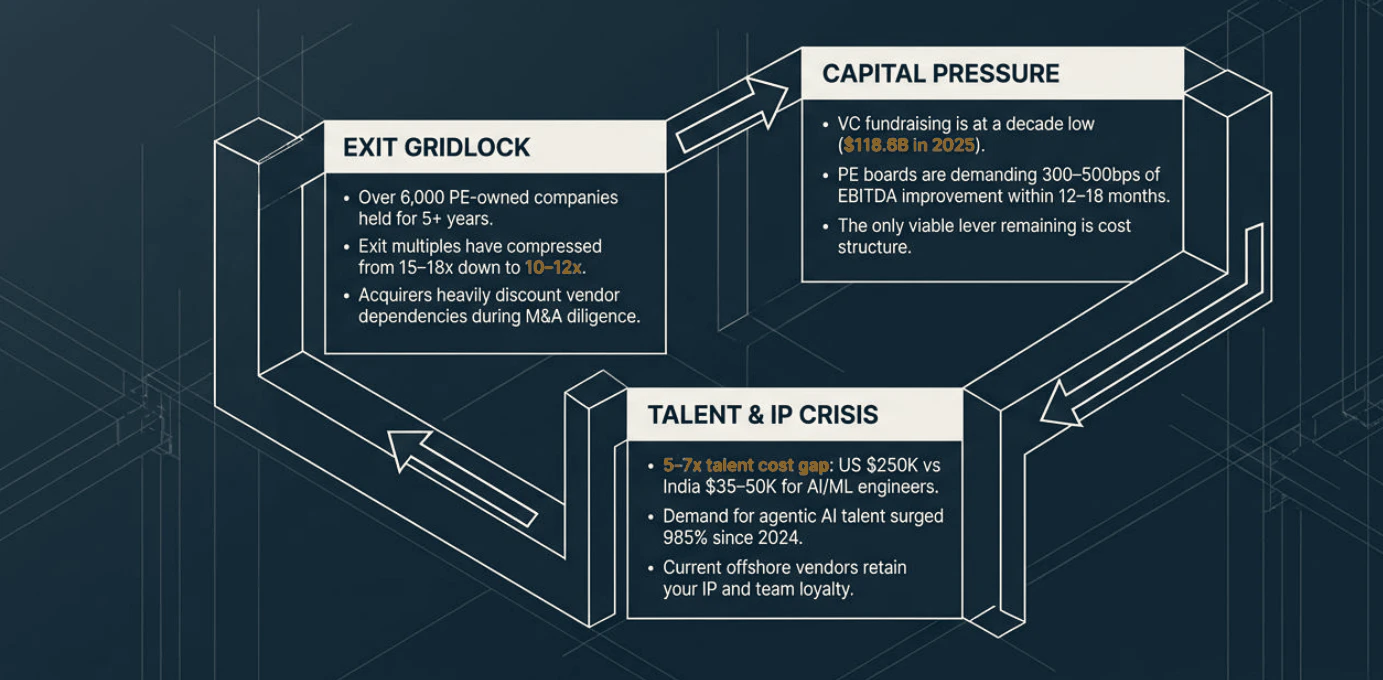
Three pressures compound on each other.

The current operational model is structurally broken: three compounding market pressures, exit gridlock, capital pressure, and a talent and IP crisis, feeding into each other in a cycle.
6,000
PE-owned companies held for five years or more.
15-18x → 10-12x
Exit multiples compressed across the holding period.
$118.6B
VC fundraising in 2025, a decade low.
5-7x
Talent cost gap: US $250K against India $35-50K for AI/ML engineers.
985%
Growth in agentic AI talent demand since 2024.
01 · Exit gridlock

Held assets, compressed multiples.

  • Over 6,000 PE-owned companies held for 5+ years.
  • Exit multiples compressed from 15-18x down to 10-12x.
  • Acquirers heavily discount vendor dependencies during M&A diligence.
02 · Capital pressure

Less capital, harder targets.

  • VC fundraising at a decade low ($118.8B in 2025).
  • PE boards demanding 300-500bps of EBITDA improvement within 12-18 months.
  • The only viable lever remaining is cost structure.
03 · Talent & IP crisis

The capability you rent, you do not own.

  • 5-7x talent cost gap: US $250K vs India $35-50K for AI/ML engineers.
  • Demand for agentic AI talent surged 985% since 2024.
  • Current offshore vendors retain your IP and team loyalty.
Cost structure is the only lever the board still controls.

Expertise directory

Choose the business context.

Select the mandate closest to yours to see the work GrowGCC applies first.

Private Equity

Screen the portfolio before investing.

Use a repeatable India lens while keeping every portfolio-company case specific.

View Private Equity expertise ↗
  1. Portfolio strategyPortfolio LensPrioritise companies by mandate, readiness and value-creation fit.
  2. AI readinessAgentic Readiness AuditTest whether operating data, workflows and leadership are ready.
  3. Operating designShared Services CentreFrame which shared capabilities belong in India and how to own them.

Where we focus

Capability into India, for the first time or the next time.

Functions
Technology, finance, shared services, R&D and agentic AI
Origin markets
US, UK, UAE, Canada and other growth markets entering India
Company stage
Growth-stage companies, including Series A to D, and PE/VC portfolios

How we work

Decide. Build. Scale.

  1. 01
    DecideStrategy & M&A

    Advisory, feasibility and GCC via M&A.

  2. 02
    BuildSetup & BOT

    End-to-end setup and Build-Operate-Transfer.

  3. 03
    ScaleTransformation & migration

    Centre transformation and outside-India migration.

Latest decision material

Explore all insights
Boardroom prepared for an India capability decision
Research framework · 6 min

Five reasons not to build an India GCC

A board-level screen for timing, ownership, leadership and mandate risk.

Open the framework ↗

Capability centre operating floor
Decision note · 8 min

Six decisions the board paper must resolve

Bring capability, structure, leadership, economics, governance and ownership into one decision.

Open the decision note ↗

Indian city business district after dark
Field note · 4 min

Define ownership before location

Why the intended end state should shape city, structure and operating choices.

Open the field note ↗

Next conversation

Bring the India decision.

Bring the decision, current state and ownership goal. We will identify the next step and the evidence it requires.